Strategy · Geopolitics · Leadership · Resilience
Geopolitical change is ultimately an institutional dilemma.
It is far easier to see what is changing than to understand how to act on it. The gap between the two is usually institutional and human, and closing it takes more than further analysis.
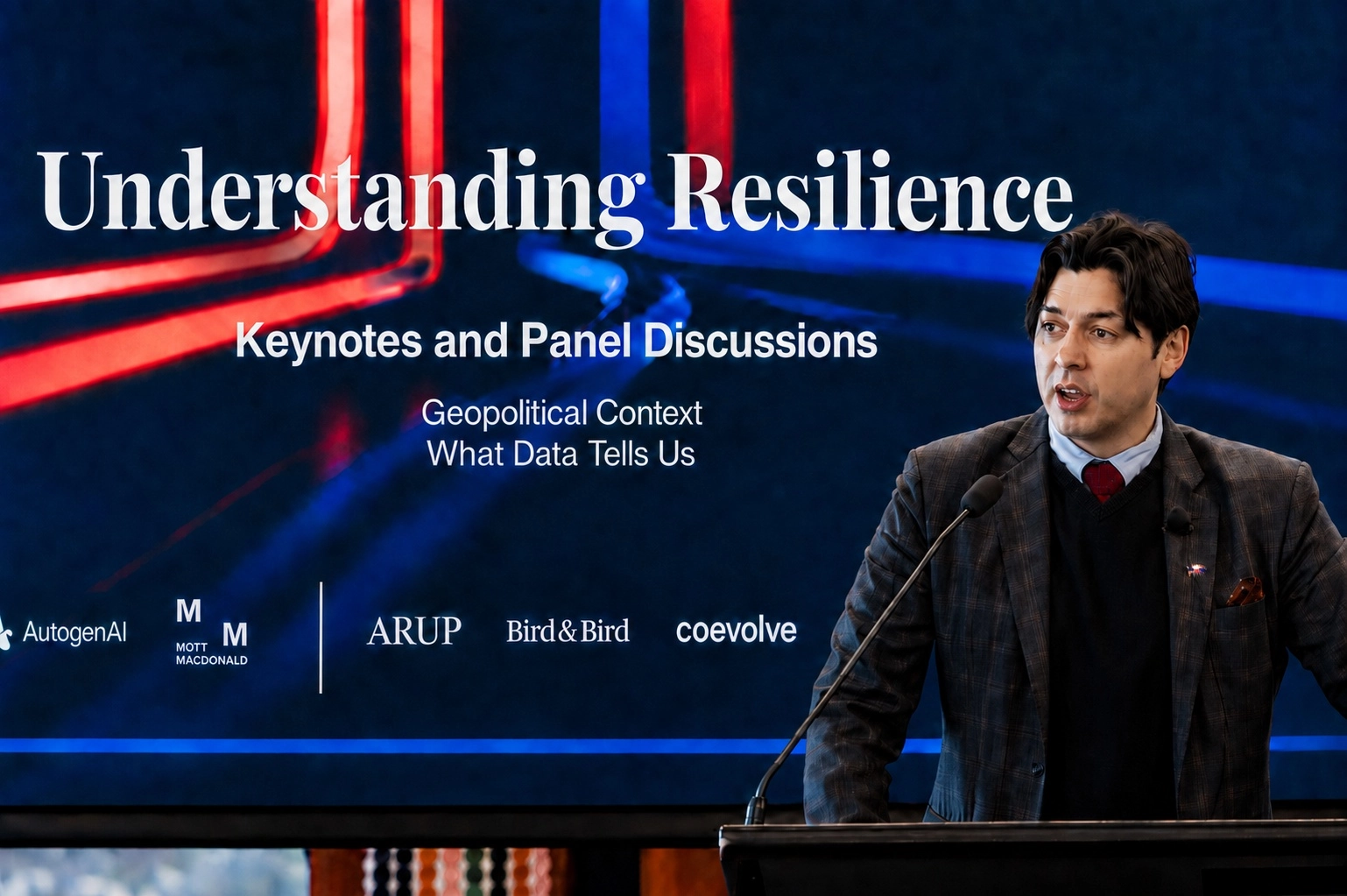
Questions of global power, politics and ideology are becoming increasingly difficult to separate from economics, technology and personal life. Critical minerals, energy security, technology standards and the security of subsea infrastructure may look like separate issues, but increasingly they reflect the same underlying problem: geopolitical change and rising insecurity are reaching individuals and organisations through the systems they still have to navigate every day.
Having worked inside military and government structures, alongside industry from major primes to small enterprises, and in environments ranging from heavily regulated systems to much lighter ones, I have learnt a good deal about what actually works when organisations are trying to keep pace with geopolitical change.
Where this comes from →Adapting to geopolitical change is a test of leadership before strategy.
Every organisation I have worked in or alongside has been full of capable, well-meaning people who wanted to do the job properly. Where friction built up, and on the rarer occasions when something did go wrong, the cause was almost never carelessness or self-interest. It sat further back, in systems that were clear about the outcome they were after but less attentive to what achieving it asked of the people delivering it, who were left to supply from their own judgement whatever the structure, the information or the authority had not given them.
Heavily regulated organisations and those that pride themselves on "agility" arrive at remarkably similar difficulties from opposite directions, almost always through the same basic questions of leadership and management, about who gets spoken to and who is genuinely heard, about how much of what an organisation knows never reaches a job title, and about whether a leader can accept challenge and still hold enough earned authority to act on it.
The five reflections below come from lessons I encountered more than once, sometimes by getting things wrong myself and sometimes by watching the same problem reappear somewhere entirely different.
FIVE REFLECTIONS ON ORGANISATIONAL RESILIENCE
At a time when major geopolitical change will keep unfolding for years, resilience is about how an organisation works, not how it reacts: the basic conditions that decide whether change is recognised and translated, and whether the people who have to act on it are backed to do so.
-
Markets can be as commercially attractive as they are strategically exposed. Organisations need to be able to recognise both.
For roughly forty years, organisations could assess markets, capital, technology and supply chains principally through price, efficiency and legal compliance, while treating national politics as a secondary consideration. That was rational, and for a long time it worked. It reflected a period in which free-market assumptions were sufficiently dominant that political difference looked like friction to manage rather than a variable to price, while interdependence was widely expected to moderate rivalry.
The bipolar Cold War and the unipolar decades that followed were historically unusual arrangements. The present has more in common with earlier periods in which several capable states pursued divergent interests at once and economic relationships could serve that competition rather than restrain it. What that looks like in practice is familiar to anyone running a business now: export controls that move faster than contract cycles, investment screening in markets that did not screen before, sanctions exposure arriving through a third party rather than a counterparty, and procurement decisions that turn on where something was manufactured rather than what it costs. The consequence is not that lucrative markets have become inherently dangerous. It is that the same market can be genuinely profitable and genuinely risky at once, in combinations that risk models built during the previous era were not designed to detect.
Facing that is not pessimism, and it is not an argument for decoupling or for treating every cross-border relationship as hostile. The reassessment is available to anyone willing to undertake it, and the advantage sits with those who do so early rather than after an event forces the question. The work is distinguishing between relationships that can be managed, dependencies that can be diversified, exposure that can be tolerated and arrangements that would compromise the ability to choose later. That is a harder discipline than either optimism or retreat, and it is the one this period rewards.
-
Adapting to change starts with knowing what the people inside an organisation already know, before deciding what genuinely needs to be brought in.
Capability attaches to people rather than to the roles they were hired into. A government desk officer covering the Middle East may speak Mandarin. A bank’s marketing team may contain the person who best understands its exposure in a difficult market. Someone in corporate affairs may have handled a version of the current problem at a previous employer, in a context nobody thinks to connect to this one. None of that appears on an organisation chart because the chart was never designed to show it. I have worked in organisations that went looking outside for something already sitting two desks away, and I did not spot it either.
That gap makes buying capability an easy first move. Dispersed expertise, formal decision rights and genuine gaps are readily conflated, and outsourcing becomes the obvious remedy for problems several people inside the organisation may already understand well. The opposite assumption, that internal presence guarantees sufficiency, is just as costly and harder to notice. The judgement lies in knowing what is genuinely absent as precisely as what is already available, and most organisations have a much better picture of the first than the second.
The same gap shows up in how strategy gets made. Practical constraints, institutional friction and the experience of those expected to deliver tend to be treated as matters to resolve once direction is set, by which point assumptions about authority, capacity, incentives and time are already fixed. Distance from delivery genuinely helps leaders see past immediate constraints, but it works only where someone can distinguish what is real, what is self-imposed and what could be changed if anyone chose to.
-
Finding what an organisation already knows depends on how it is built. Large organisations famously lose time to process; smaller ones can lose just as much rebuilding what useful process should have preserved.
The familiar criticism of large organisations is that process accumulates until it becomes the work, and that criticism is often justified. A less examined failure runs in the opposite direction. Organisations that equate light structure with speed do not remove the work of coordination. They move it onto individuals, who then spend their attention locating information, reconstructing decisions that were never written down, working out who owns what and rebuilding systems that should already exist.
That cost is largely invisible because nobody is formally assigned it. Most organisations have one or two people who function as the unofficial index of what is going on, and it falls hardest on them, compounding under pressure at exactly the point when those people are most needed thinking rather than chasing information.
The useful question is not how much structure an organisation has, but what its structure is for. Structure that records decisions, preserves information and makes responsibility legible is what allows people to move quickly. Structure that exists principally to demonstrate control does the opposite. Both are called process, and from the top of an organisation the two can look almost identical. That makes it easy to remove the structure that was quietly enabling people to move quickly.
-
The same judgement applies when an organisation explains itself outward. Explaining what can safely be said is a separate discipline from deciding what must remain protected, and credibility depends on doing both well.
Protecting sensitive information is a serious institutional responsibility. So is maintaining the confidence of the people whose consent, custom, capital or political support an organisation depends on. Social media, disinformation and near-continuous scrutiny have made those two responsibilities harder to hold at the same time. A ministry, bank or major company may have entirely good reasons for withholding detail and still need to explain enough of its reasoning for people to understand why its decisions are credible.
The difficulty is that four categories are easily collapsed under pressure: information that must remain protected, information that is commercially or politically uncomfortable, information already available to anyone who looks, and information that could be explained safely given the right context. When they collapse into one, communications teams are left with assertion while the strongest evidence stays inside the institution.
Public confidence does not require complete transparency. It requires evidence that an organisation can tell necessary confidentiality apart from avoidable opacity. In an environment where false claims travel quickly and repetition hardens them into belief, silence is not always neutral. What makes this genuinely hard is that the judgement is usually made at speed, by people who will be criticised for getting either side of it wrong. In those conditions, the individually defensible choice is often to say less than could safely have been said.
-
None of it happens without people willing to decide. Capable people can tell the difference between being trusted and being left to carry risk, and they remember which one they were given.
Being told to take initiative is not the same as being trusted with responsibility. Genuine empowerment rests on clarity of purpose, access to the information on which decisions actually turn, and confidence that reasonable judgement will be supported at senior levels, including when a decision made logically and in good faith produces the wrong result. This is not about shielding people from accountability. It is about recognising the difference between incompetence and an honest mistake made under uncertain conditions.
The difficulty is not that leaders are indifferent to this. Standing behind someone whose defensible decision produced a bad outcome means absorbing that outcome upward into your own accountability, often in front of people who were not in the room and will judge it principally by the result. Declaring people empowered carries no equivalent cost. I have been on both sides of that asymmetry. The real test of delegation is not whether a leader welcomes a good outcome they did not control, but whether they will own a reasonable decision that went wrong.
That protection matters most when people are exercising judgement in conditions shaped by events outside the organisation and outside their immediate expertise. An organisation that cannot absorb reasonable failure will gradually fill with people who wait to be told what to do, precisely when speed and judgement matter most.
Putting the reflections to work
Ideas matter most when they meet a real decision.
These reflections and more come alive when tested against real questions by people who have decisions to make or knowledge to develop.
Through chairing and MC'ing, teaching and mentoring, and analysis and commentary, I help organisations, professional and academic audiences examine complex issues clearly, challenge assumptions and make accessible wider geopolitical and institutional change impacting us all.
Analysis & Commentary
Testing ideas on the page.

Writing is my filter to best understand complex issues myself. I publish because an argument put on the record is about accountability as much as credibility. My goal is always to identify what matters, explain why, and make complexity legible to people who want to understand it without already being experts.
That work has appeared through the Lowy Institute, the Australian Strategic Policy Institute, The Diplomat, the Wavell Room and defence journals including the British Army Review. The Security Sitrep is the continuing home for everything else, following the same sequence each time: what happened, why it matters and what it means for the decisions that follow.
Recent analysis
- 12 June 2026 The Diplomat AUKUS After AUKMIN: The Test Beyond Washington
- 10 June 2026 Lowy Institute · The Interpreter Actually, the UN is broken – and that’s exactly why reform matters
- 13 May 2026 Lowy Institute · The Interpreter The budget patches an energy system built for a different world
- 12 March 2026 The Diplomat The Iran War Is Now Impacting AUKUS
Continue